
Last Updated November 5, 2026.
What is Generative BI?
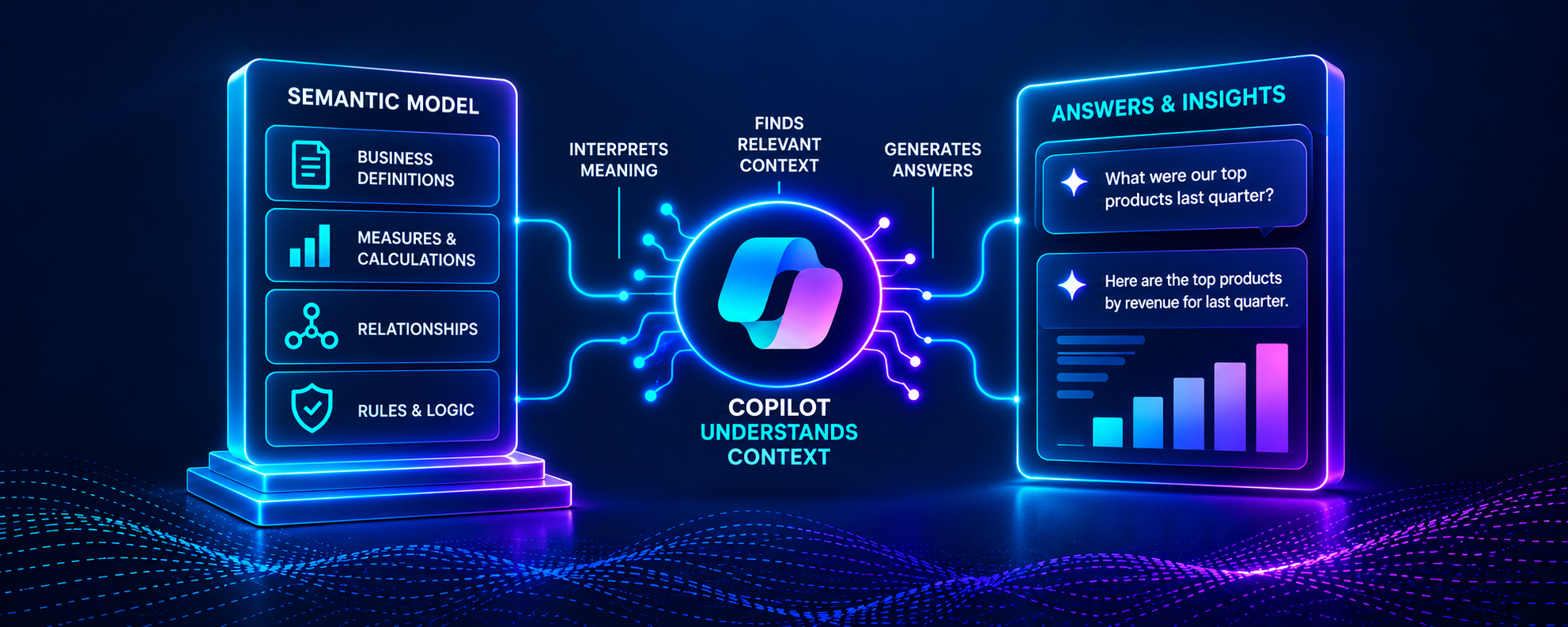
Generative BI applies generative AI to business intelligence, grounded in trusted business data and meaning, so a system can answer questions, explain results, and help people decide what to do next. Conversational analytics describes how people interact with that system; Generative BI describes what the system can do.
It works only as well as the business context behind it. Giving an AI access to your data is not the same as giving it an understanding of your business. For Power BI teams, that context starts with the semantic models you already have.
Generative BI, Conversational Analytics, and Conversational BI
These terms overlap. This is how I use them:
| Term | What it means | Where it fits |
|---|---|---|
| Generative BI | Generative AI applied to business intelligence, grounded in trusted data and business meaning. It can answer questions, explain changes, compare parts of the business, and flag patterns. | The overall capability and the goal |
| Conversational analytics | Asking questions of business data in natural language and getting answers back. | The interface to a Generative BI system |
| Conversational BI | The same idea in a business intelligence setting. The name avoids confusion with conversation analytics, which analyzes call-center transcripts. | A synonym for conversational analytics |
| Power BI Copilot | Microsoft's AI assistant in Power BI, which answers questions using your semantic models and reports. | One product that delivers it |
| Fabric data agent | A Fabric item that answers questions over sources such as warehouses, lakehouses, Power BI semantic models, and Fabric IQ ontologies. | Another product that delivers it |
What can a Generative BI system do?
A chat window is only the front door. A Generative BI system might help a user:
Answer a business question, such as "What were sales of Product X in North America last quarter?"
Explain why a metric changed.
Connect related business concepts.
Flag unusual patterns for investigation.
Compare one part of the business with another.
Eventually guide people toward the right action.
Retrieving a number is the easy part. A question like "Which distributors should we focus on next quarter?" forces the system to decide what "focus on" means in your business: highest revenue, fastest growth, lowest risk, or something else.
Why Generative BI is More than Text-to-SQL
Turning a question into a query is not where these systems fail. Anthropic's data team, describing how it built self-service analytics on Claude, reports that accuracy is a context and verification problem rather than a code-generation problem, and that without curated skills its accuracy on internal evaluations did not exceed about 21%, rising above 95% with them.
Read the full account: How Anthropic enables self-service data analytics with Claude.
The lesson applies to every platform. The model is rarely the hard part. The hard part is giving it explicit business meaning.
What Generative BI Needs: Business Meaning
A Power BI semantic model can work perfectly for dashboards and still confuse an AI. A developer knows which of the measures Sales, Sales2, NetSales, and TotalSalesFinal belongs on the executive dashboard. An AI has to guess.
Reducing that guesswork means making these things explicit:
Authoritative measures, so the AI never has to choose between near-duplicates.
Business-friendly names and descriptions that explain meaning and intended use.
Date roles, so "last quarter" uses the right date.
Relationships that say what the business connects, not just which keys join.
Business rules and analytical guidance that otherwise live in people's heads.
I call this semantic enrichment. Start with Why Semantic Enrichment Is the Foundation of Generative BI and Is Your Power BI Semantic Model Ready for AI?
How Generative BI Works on the Microsoft Stack
Three layers work together, and none has to replace another:
Power BI semantic models provide trusted analytical meaning: measures, hierarchies, relationships, and calculations.
Fabric IQ ontologies provide shared business meaning across domains and data sources. A semantic model describes how we analyze the business; an ontology describes what the business is.
Agents give people an interface, such as Copilot in Power BI, Microsoft 365 Copilot Chat, Teams, or a custom agent.
My default advice is to start with the semantic models you already trust, enrich them, and add an ontology when your use case crosses semantic-model boundaries. Details: How Do Power BI Semantic Models, Fabric IQ Ontologies, and Agents Work Together?
Status of key Microsoft capabilities as of November 5, 2026. These change quickly, so check the linked sources.
| Capability | Status | Source |
|---|---|---|
| Fabric IQ workload | Preview | Microsoft Learn: Fabric IQ overview |
| Ontology in Fabric IQ | Preview | Microsoft Learn: Fabric IQ overview |
| Fabric data agent in Copilot in Power BI | Preview | Microsoft Learn: data agent in Copilot |
| Prep data for AI (AI instructions, verified answers, AI data schemas) | Preview | Is Your Power BI Semantic Model Ready for AI? |
| App-scoped Copilot | Preview | What Happens When Power BI Copilot Has Multiple Semantic Models? |
Is Your Power BI Model Ready for Generative BI?
Five quick checks:
Would a business user understand the names of your important tables, columns, and measures?
Is it obvious which measure is the official version of each key metric?
Do the important objects have descriptions that explain meaning and when to use them?
Does the model clearly show how the main business concepts relate?
Is critical business knowledge written down somewhere an AI can reach it?
If several answers are no, the model may be dashboard-ready without being Generative BI-ready. The full checklist is in Is Your Power BI Semantic Model Ready for AI?
Frequent Asked Question (FAQs)
What is Generative BI?
Generative BI applies generative AI to business intelligence, grounded in trusted business data and meaning. It can answer questions, explain results, compare parts of the business, and help people decide what to do next.
Is Generative BI the same as conversational analytics?
No, though they overlap. Conversational analytics is the interface: asking questions of data in natural language. Generative BI describes what the system behind that interface can do. Conversational BI is another name for conversational analytics in a business intelligence setting.
Is Generative BI just text-to-SQL?
No. Generating a query is the easy part. Reliable answers depend on business definitions, authoritative metrics, relationships, and rules that the data schema alone does not contain.
Do I need a Fabric IQ ontology to do Generative BI?
Not necessarily. For many analytical questions, a well-enriched Power BI semantic model is enough. Consider an ontology when your questions cross multiple semantic models or data sources, or when several agents need the same shared business vocabulary.
Does Power BI Copilot count as Generative BI?
Copilot in Power BI is one way to deliver it. Its answers depend heavily on how well your semantic model describes the business, which is why Power BI's Prep data for AI features, such as AI instructions, verified answers, and AI data schemas, matter.
Will Generative BI replace dashboards?
I don't think so. Dashboards are built around questions someone anticipated. Generative BI handles the questions nobody anticipated. The two work together.
How accurate is Generative BI?
Accuracy depends on the context you give the system, and AI answers are probabilistic, so even a well-prepared model can occasionally surprise you. Test with realistic business questions before rollout and treat maintenance as ongoing work.
Related Reading
Welcome to Generative BI with Fabric IQ: an introduction and why business context matters.
Generative BI: Beyond Conversational Analytics: why Generative BI is more than asking questions of data.
How Does Power BI Copilot Use Your Semantic Model?: AI data schemas, verified answers, and AI instructions.
What Happens When Power BI Copilot Has Multiple Semantic Models?: app-scoped Copilot and semantic governance.
What Is an Ontology in Microsoft Fabric IQ? and How Do You Model an Ontology in Microsoft Fabric IQ?
Fabric IQ Ontologies Require a Modeling Methodology and Can ORM2 Help You Model Fabric IQ Ontologies?
The full hub: Generative BI with Power BI & Fabric IQ
Greetings! I’m Dave Langer
Author | Microsoft MVP | LinkedIn Top Voice

I help Power BI teams move past dashboards to Generative BI using Microsoft Fabric and Fabric IQ.
If your organization is serious about enterprise-class conversational analytics, we should talk.