
Originally published August 10, 2026. Updated October 2026 to reflect current Fabric IQ terminology and capabilities.
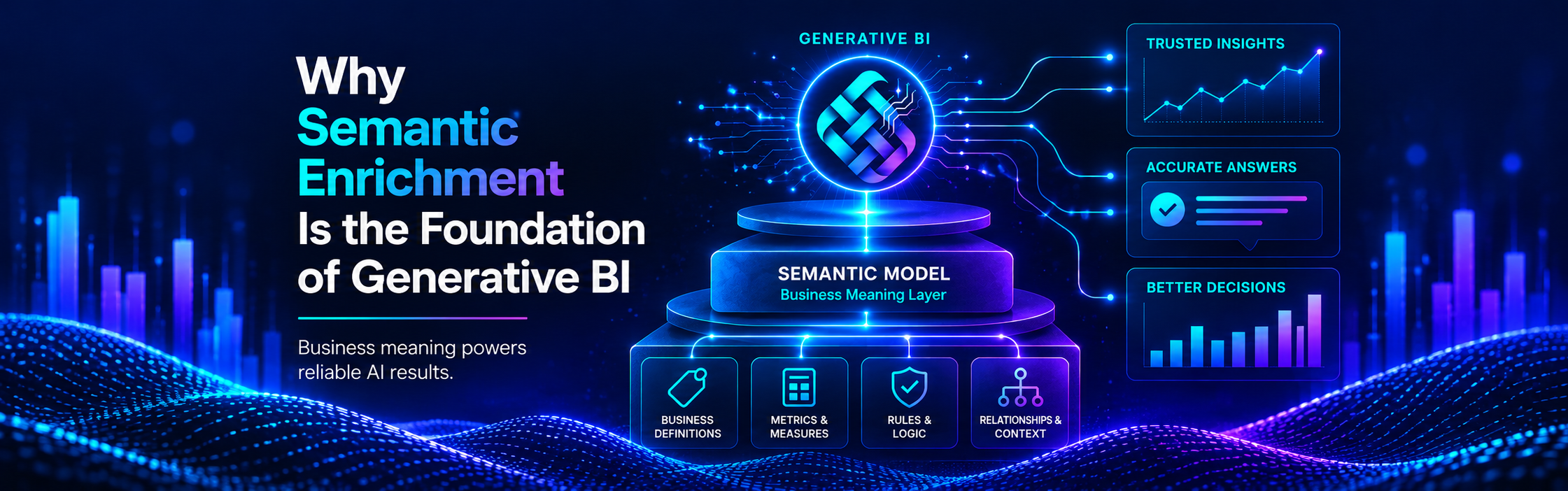
Why Semantic Enrichment Is the Foundation of Generative BI
Key takeaway: Semantic enrichment gives AI the business meaning it cannot reliably infer from data structures alone. By making definitions, metrics, relationships, rules, and context explicit, Power BI teams can turn existing semantic models into a stronger foundation for accurate, trustworthy Generative BI.
LLMs Aren’t That Smart
Large language models (LLMs) seem capable of doing magical things with natural language. However, that doesn't mean they actually understand your business.
An LLM might know what a customer is. It might know what revenue is. It might even understand the general idea of a sales territory.
But it doesn't automatically know what your company means by those things:
Which customers count as active?
When does a distributor become high value?
Which revenue measure should an executive use?
What does "Midwest" mean in your sales organization?
Which date should be used when someone asks about sales last month?
Those answers don't live in the LLM. They live in your business.
And if you want AI systems to deliver reliable answers to your business users, you need to make that meaning available to them.
This is why semantic enrichment is the foundation of Generative BI.
What is Semantic Enrichment?
You can think of semantic enrichment as the process of adding business meaning to data so that people, and increasingly AI agents, can understand how that data should be interpreted and used.
Some of that meaning is already obvious to experienced BI professionals:
It's likely that SalesAmount represents revenue.
It's likely that OrderDateID connects a sales transaction to a Date dimension.
It's likely that a relationship between Customer and Geography records where the customer is located.
But likely is exactly the problem. Generative AI needs more than clues. It needs context. Semantic enrichment makes that context explicit. This enrichment can include:
Hierarchies.
Clear descriptions.
Business-friendly names.
Synonyms and terminology.
Trusted measures and calculations.
Relationships between business concepts.
Business rules and guidance on how data should be interpreted.
The goal is straightforward:
Describe the business so well that AI doesn't have to guess.
And we all know that LLMs love to guess (aka hallucinate), and they always sound so confident when they do it!
Data Access IS NOT Business Understanding
One of the easiest mistakes in Generative BI is assuming that giving AI access to data means it understands the data. It doesn't. Imagine giving a Fabric data agent access to a OneLake lakehouse containing tables such as:
FactDistributorSales
DimGeography
DimDistributor
DimProduct
DimDate
Technically, that's a lot of useful information. The schema tells the Fabric AI agent something about how the data is organized. Foreign keys indicate how rows can be joined. Column names give it hints about what values represent.
Now imagine asking the AI agent the following:
"Which customers should we consider inactive?"
The schema alone cannot answer that question. Consider the types of follow-up questions BI teams are likely to ask:
What does inactive mean?
No purchases in 30 days?
90-180 days? A full year?
Does the definition differ by customer type?
Should customers with an active contract still count as active even if they haven't purchased recently?
Those answers aren't contained in the table structure. They come from business rules and definitions.
That's a semantic problem. And here's the reality.
Your business stakeholders will rapidly go from using Generative BI for simple calculation retrieval to analysis and recommendations.
Because that's where the real business value lives.
And that's where Generative BI goes far beyond letting a Fabric data agent access your OneLake tables and Power BI semantic models.
The More Valuable the Question, the More Semantics Matter
Consider these two questions:
"What were distributor sales last quarter?"
"Which distributors appear to be losing momentum?"
The first question is relatively constrained. If the AI agent (e.g., Copilot) knows the correct sales measure, distributor dimension, and date logic, it has a reasonable path to an answer.
It's also less valuable to the business.
The second question is different. The first question is Descriptive Analytics. The second is Diagnostic Analytics.
You can easily imagine a sales leader asking the second question when distributor sales aren't trending toward their key performance indicator (KPI) goal, and they're looking for actionable intelligence to turn things around.
So, from the AI agent's perspective, what does "losing momentum" mean?
Declining revenue?
Declining order frequency?
A drop in average order value?
A decline compared with last year?
A decline relative to similar resellers?
This is one reason Generative BI is bigger than conversational analytics. A chat interface makes it easy to ask questions. It does not make ambiguity disappear.
If anything, natural language adds more ambiguity because business users ask questions in terms of business concepts, not Power BI semantic model terminology.
And here's the reality we all know.
No matter how much you train business stakeholders on your organization's business concepts and terminology, they will inevitably use different language. Moreover, they will expect the Generative BI solution to be "smart" enough to translate on their behalf.
That level of flexibility, while generating accurate responses, comes only from a powerful semantic layer - a layer that's far more than star schemas and DAX code.
Power BI Teams Aren't Starting Over
If your organization has spent years investing in Power BI semantic models, I've got good news for you:
You're not starting from scratch.
A well-designed semantic model already contains a significant amount of business knowledge:
It contains relationships.
It contains calculations.
It contains hierarchies.
It contains measures.
And, hopefully, it contains business-friendly names and descriptions.
Power BI semantic models already sit between raw enterprise data and the business users who consume it. For years, Power BI teams have mainly thought of the semantic model as what powers reports and dashboards.
Generative BI gives us another way to look at it:
Your Power BI semantic model is a machine-readable description of how the business wants its data to be understood.
That makes it a key foundation for using Copilot and Fabric data agents to deliver Generative BI to your business stakeholders.
Microsoft's strategy reinforces this. Power BI now includes Prep data for AI, a set of features designed to help semantic model developers improve how AI agents interpret and use Power BI semantic models.
And I would argue that, even more importantly, Fabric IQ allows you to bootstrap an ontology from a Power BI semantic model. But that's a story for an upcoming newsletter.
In other words, Microsoft's strategy is not asking Power BI teams to throw away the semantic work they have already done.
It's building on top of it.
Dashboard-Ready Doesn't Mean AI-Ready
This is where things get interesting. A semantic model can work perfectly well for dashboards and still create problems for AI.
Why?
Because humans bring business context with them. Suppose a semantic model contains four DAX measures:
Sales
Sales2
NetSales
TotalSalesFinal
The person who built the semantic model may know exactly which one should appear on the executive dashboard. The AI doesn't have that institutional knowledge.
The same problem appears with columns such as:
Status
Name
Value
Type
Date
These names may be technically valid. They may even work perfectly well when a developer manually selects them for a visual. But they force an AI system to infer meaning from limited evidence.
That is an anti-pattern for Generative BI. And naming is only one example.
Power BI semantic models can also contain redundant measures, hidden business rules, ambiguous relationships, poorly documented calculations, or fields that make sense only to the people who built the model.
None of those necessarily prevent a dashboard from working.
But they make an AI-powered experience much less reliable.
Semantic Enrichment Goes Beyond DAX
Power BI professionals are accustomed to putting enormous effort into DAX. And that makes total sense. DAX measures are where much of the business logic in a semantic model lives.
But real-world Generative BI requires more than correct calculations. AI also needs context around those calculations. Compare a measure called:
Revenue
with a Revenue measure that includes this description:
Net product revenue after discounts and returns. Use this measure for standard executive sales reporting. Excludes tax and freight.
The DAX might be identical. The second version provides significantly more business context. The same principle applies throughout the model:
What does this column mean?
When should this measure be used?
How does this metric differ from another similar metric?
Which terminology do business users use when referring to this concept?
In addition, Power BI teams need to give serious thought to questions like:
Which tables, columns, and measures should AI prioritize?
What should AI avoid?
Those are semantic questions, not DAX questions.
And answering them is critical to preparing a Power BI semantic model for use with Copilot and Fabric data agents.
What Does an AI-Ready Semantic Model Look Like?
I'm going to be completely honest here. We're still early in the rise of Generative BI. For example, Power BI's Prep data for AI feature and Fabric IQ are still in Preview.
So, while there will be inevitable changes coming from Microsoft, one thing will remain true regardless of these changes:
There isn't a single switch that makes a semantic model "AI-ready." It's more useful to think in terms of reducing ambiguity for the AI agent.
An AI-ready semantic model should move toward:
Clear business terminology - Tables, columns, and measures should use names a business user can understand.
Authoritative measures - AI should not have to choose between several nearly identical versions of the same metric.
Useful descriptions - Descriptions should explain meaning, business use, and important distinctions, not simply repeat the object's name.
Understandable relationships - The model should make it clear how business concepts relate to one another.
Less unnecessary complexity - Objects that add noise or ambiguity can make AI's job harder.
Explicit business context - Important terminology, rules, assumptions, and analytical guidance should not exist only in someone's head.
Notice what is happening here.
We're taking knowledge that used to live only in the minds of business stakeholders and Power BI developers and making it part of the model.
That's semantic enrichment.
The BI Team's New Responsibility
Historically, BI teams have spent a lot of time asking:
What report, scorecard, or dashboard should we build?
How should users navigate through it?
Which filters should we expose?
Which visuals should we use?
Those questions aren't going away. But Generative BI adds another:
How should we describe the business so AI can work with it reliably?
That is a different kind of design problem.
It requires working with business stakeholders to define concepts. It requires resolving conflicting terminology. It requires deciding which measures are authoritative. It requires documenting meaning that may currently exist only in people's heads.
And it requires thinking about semantic models not only as a reporting layer, but as a source of business knowledge for AI.
Make no mistake.
The most important work in Generative BI happens before you hook up a Fabric data agent to your Power BI semantic model.
The Competitive Advantage Will Be Semantics
Power BI teams across all manner of organizations worldwide will have access to the same features and capabilities - including your organization's competitors.
That means your competitors will also benefit from Microsoft's substantial investments in building real-world Generative BI solutions.
So, if the technological foundations are the same, how does your BI team help your organization compete?
By leveraging what makes your organization unique:
Your institutional knowledge.
Your relationships.
Your definitions.
Your metrics.
Your rules.
That's proprietary. That's the advantage.
And this is where Power BI teams have an enormous opportunity. The organizations that get the most value from Generative BI may not be the ones using every Power BI and Fabric feature.
It will be the organizations that do the best job of describing their business holistically to Fabric data agents and Copilot.
And for many organizations, it starts with the Power BI semantic models they already have.
Next up: Is Your Power BI Semantic Model Ready for AI?
Greetings! I’m Dave Langer
Author | Microsoft MVP | LinkedIn Top Voice

I help Power BI teams move past dashboards to Generative BI using Microsoft Fabric and Fabric IQ.
If your organization is serious about enterprise-class conversational analytics, we should talk.