
SEMANTIC MODEL ENRICHMENT
Add Business Meaning So AI Understands Your Data
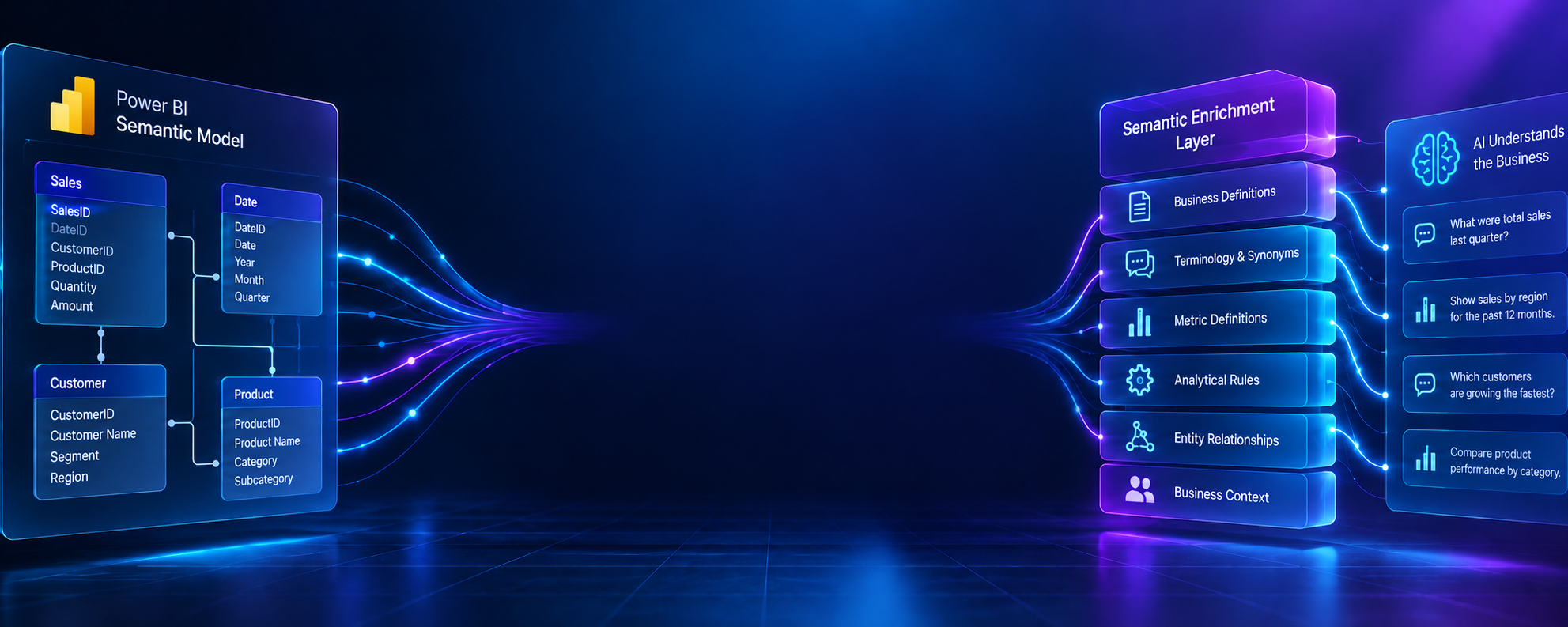
I help Power BI teams enrich their semantic models with definitions, terminology, relationships, and analytical context so AI can interpret business questions more accurately.
WHY SEMANTICS MATTER
AI Needs More Than Just Data
A semantic model may contain the right tables, measures, and relationships and still leave important business meaning unstated. That’s where semantic model enrichment comes in.
Humans often fill in those gaps naturally.
They know what “sales” means.
They know which date to use.
They know whether an order count should count rows or distinct orders.
They know how the business defines margin, customer, product, or region.
AI doesn’t automatically know those things.
When the model leaves important meaning implicit, AI has to infer - and that leads to mistakes.
Semantic enrichment makes that meaning explicit.
WHAT GETS ENRICHED
Make the Business Meaning Visible
Business Definitions
Define important business concepts clearly so AI understands what they mean in your organization.
Analytical Rules
Provide guidance about date roles, grain, assumptions, filtering, and other analytical decisions.
Terminology & Synonyms
Connect the language business users actually use to the language in the semantic model.
Relationships & Context
Make important entity relationships and business context easier for AI to interpret correctly.
Metric Definitions
Clarify what key measures mean, how to calculate them, and when to use them.
Business Instructions
Capture important domain knowledge that would otherwise live only in the heads of analysts or report developers.
HOW IT WORKS
From Semantic Model to Semantic Understanding
1. Start With the Existing Model
Review the semantic model as it exists today, including:
Tables
Columns
Measures
Relationships
Hierarchies
Naming
Descriptions
The goal is to understand what the model already communicates - and what it leaves unclear.
2. Add the Missing Business Meaning
Enrich the model with the context AI needs, such as:
Definitions
Synonyms
Metric descriptions
Analytical guidance
Business rules
Relationship meaning
Domain-specific context
3. Test With Real Business Questions
Use realistic questions to evaluate whether the enriched model helps AI interpret the business more consistently.
Then you refine the semantic layer and analytical guidance based on what the testing reveals.
Semantic enrichment is not documentation for documentation’s sake. It’s about reducing ambiguity.
A SIMPLE EXAMPLE
The Difference Between Data and Meaning
Imagine a model contains: Sales Amount
A human analyst may already know that this means:
Distributor net sales
Reported in USD
Based on order date unless the question is about shipping
Calculated at the sales-order-line level
Aggregated across distinct sales orders where appropriate
AI may not know any of that unless the model tells it.
Semantic enrichment turns: Sales Amount
into: a business concept with a definition, context, and rules for interpretation.
That’s the difference between giving AI access to data and giving AI enough meaning to use that data responsibly.
WHERE POWER BI FITS
Power BI Already Contains Part of the Semantic Layer
Your existing Power BI semantic models aren’t starting from zero.
They already contain valuable meaning through:
Measures
Relationships
Hierarchies
Calculation logic
Business-friendly names
Descriptions
Report conventions
Semantic enrichment builds on that foundation.
The objective is to identify where important business meaning is still implicit, inconsistent, or missing - and make it easier for AI to interpret.
BEYOND POWER BI
Semantic Enrichment Becomes Even More Important With Ontologies
As organizations move toward Fabric IQ, ontologies, and more advanced Generative BI use cases (e.g., ad hoc analysis), the need for explicit business meaning only increases.
Ontologies can represent richer concepts, entities, and relationships.
But the same fundamental question remains:
Does the system clearly express how the business works?
Power BI semantic model enrichment provides the necessary first piece in that progression. The second piece is Fabric IQ ontologies.
MY APPROACH
Make AI Guess Less
My approach is simple:
Identify the places where AI is being asked to infer business meaning, then make that meaning explicit.
That may involve improving:
Terminology
Metric definitions
Relationships
Date roles
Analytical rules
Model descriptions
Business context
Testing and validation
The goal is not to make the semantic model more complicated.
The goal is to make the business easier to understand.
The less AI has to guess, the more trustworthy the analytical experience becomes.
WHAT AN ENGAGEMENT CAN INCLUDE
Semantic Enrichment Services
Semantic model review
Business terminology analysis
Metric and measure definition
Description and synonym strategy
Date-role guidance
Grain and analytical-rule definition
Relationship-context review
AI instruction development
Conversational analytics testing
Semantic enrichment roadmap