
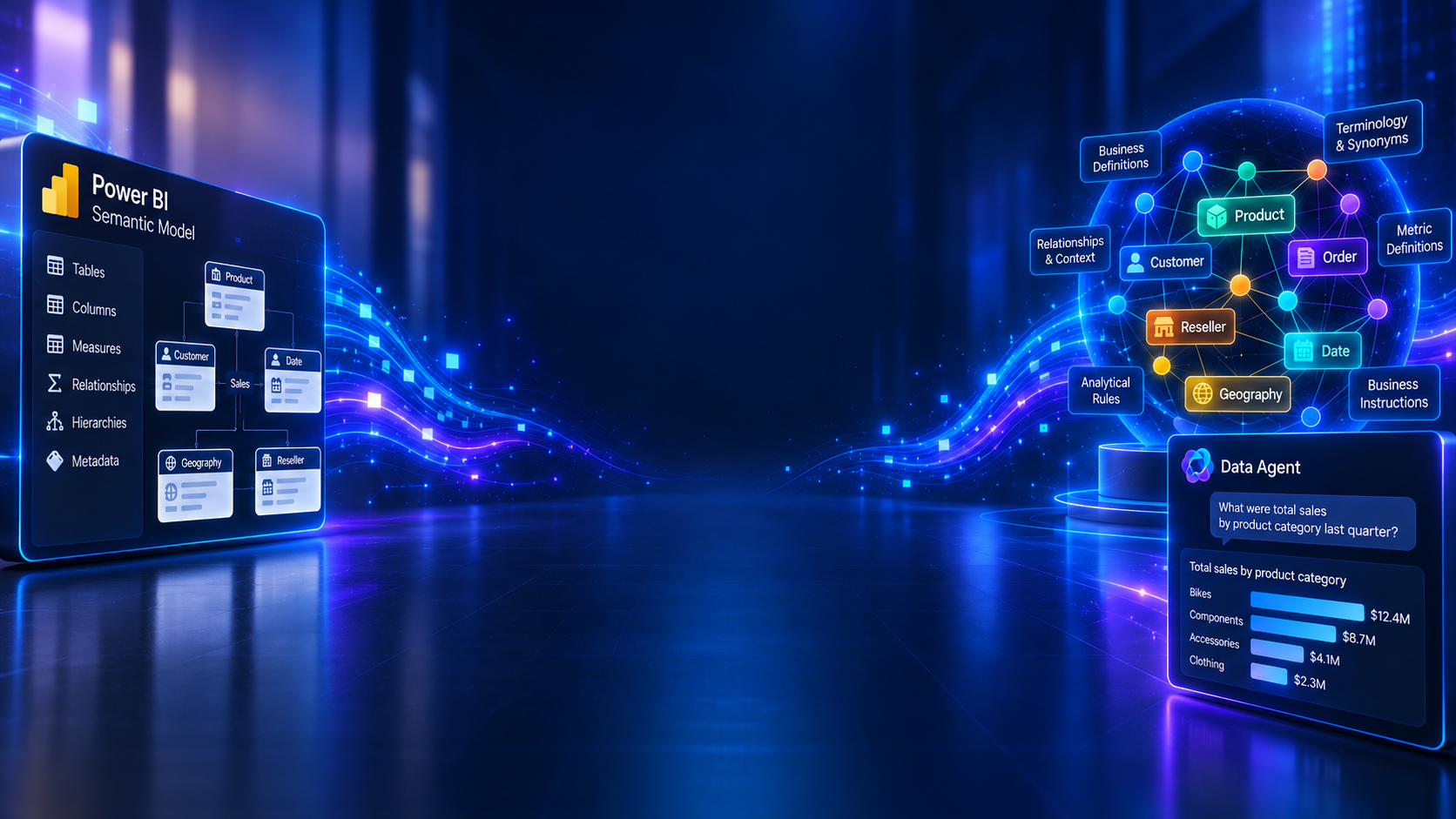
FABRIC IQ & ONTOLOGIES
Unlock Deeper Insights with Fabric IQ
I help organizations understand how Power BI semantic models, Fabric IQ ontologies, graph, and AI agents fit together so business meaning is modeled explicitly and AI can work with richer context.
WHY ONTOLOGIES MATTER
Some Business Meaning Doesn’t Fit Neatly Into a Semantic Model
Power BI semantic models excel at defining measures, relationships, hierarchies, and analytical logic. So, where do Fabric IQ ontologies fit in?
As Generative BI evolves, organizations will need to represent business concepts and relationships more explicitly across domains and data sources.
For example:
Customers belong to segments
Products belong to categories
Resellers operate in territories
Orders involve customers, products, dates, and channels
Business concepts may need shared definitions across multiple semantic models to enable true enterprise-class Generative BI experiences
Fabric IQ ontologies provide a semantic layer for expressing that shared business vocabulary through entity types, relationships, properties, rules, and bindings to real data.
POWER BI + FABRIC IQ
Your Power BI Models Can Still Be the Starting Point
Organizations already using Power BI aren’t starting from scratch. Your Power BI semantic models already contain valuable knowledge:
Measures
Relationships
Hierarchies
Business-friendly names
Analytical logic
Metadata
Established business definitions
Fabric IQ can build on that foundation.
Microsoft specifically positions semantic models and ontology as complementary.
Semantic models provide trusted KPIs and analytical structure, while ontology provides shared business language and relationships that can be used across semantic models and AI agents.
The key question becomes:
Which business concepts are already well represented in Power BI, and which ones need richer semantic modeling in an enterprise ontology?
A SIMPLE EXAMPLE
From Tables to Business Concepts
Imagine a Power BI model with:
Customers
Products
Orders
Dates
Geography
Distributors
In the semantic model, those objects primarily support filtering, aggregation, measures, and reporting.
In an ontology, those same concepts can be represented explicitly as business entities with named relationships such as:
Customer places Order
Order contains Product
Distributor operates in Geography
Product belongs to Category
The data may be similar.
What changes is the way the business meaning is modeled and governed.
That richer semantic structure gives AI agents more context for interpreting questions.
ONTOLOGY VS. GRAPH
Ontology Defines Meaning. Graph Executes Relationships.
A Fabric IQ ontology and Graph in Microsoft Fabric are related, but not the same.
The ontology defines:
Entity types
Relationships
Properties
Rules
Constraints
Business meaning
Bindings to data
A graph provides graph-oriented storage, traversal, and analysis over nodes and edges (i.e., it’s a graph database).
Microsoft summarizes the distinction neatly:
The ontology declares what connects and why.
The graph stores data and traverses those connections.
An ontology can also be materialized into a graph for exploration and graph-based analysis, but graph materialization is separate and is not required simply to have an ontology.
That distinction matters because the ontology is fundamentally about semantic meaning, while a graph is about working with connected data.
WHERE AI AGENTS FIT
Ontologies Give AI a Shared Business Language
AI agents can use Fabric IQ ontology context to work with more than raw tables and columns.
Instead, they can work with:
Entity types
Relationships
Definitions
Rules
Metrics
Data source mappings
Microsoft positions this as a way to give agents a governed, shared understanding of the business so responses are more grounded, consistent, and explainable.
The objective is not merely to give an agent access to data.
The objective is to give the agent a clearer model of what the business concepts mean.
This understanding is required for truly enterprise-class Generative BI experiences.
WHEN AN ONTOLOGY MAKES SENSE
Not Every Organization Needs to Start With Ontologies
Fabric IQ ontologies can be valuable, but they are not automatically the first step for every Power BI team.
An ontology may make sense when:
Business concepts span multiple semantic models or data sources
Shared definitions need to be governed across domains
Relationships need more explicit business meaning
Multiple agents need a common semantic foundation
Conversational analytics requires richer context
The organization is moving toward a broader Fabric IQ architecture
For many organizations, the practical path is:
Start with existing Power BI semantic models → enrich them → identify semantic gaps → introduce ontology where it adds value.
That keeps the architecture purposeful instead of adding complexity too early.
MY APPROACH
Model the Business Before You Model the Technology
My approach starts with the business concepts and relationships that matter - not with the ontology tool itself.
That means asking:
What are the core business entities?
How are they related?
Which definitions need to be shared?
Where does business meaning currently live?
Which concepts are ambiguous?
What should AI understand explicitly?
Which relationships actually matter to the business?
Only then should those concepts be mapped into Fabric IQ.
A useful ontology is not just technical metadata. It’s an explicit model of how the business understands its data.
WHAT AN ENGAGEMENT CAN INCLUDE
Fabric IQ & Ontology Services
Fabric IQ readiness assessment
Ontology use-case discovery
Business entity identification
Relationship modeling
Semantic model-to-ontology mapping
Ontology design strategy
Semantic enrichment planning
Graph use-case identification
Agent grounding strategy
Ontology testing and validation
Generative BI roadmap development
THE BIGGER PICTURE
Ontology Is One Part of the Fabric IQ Architecture
Fabric IQ brings together several related capabilities.
A typical architecture may include:
Power BI semantic models
Semantic enrichment
Fabric IQ ontology
Data and operations agents
Conversational analytics
Microsoft Fabric data sources
The pieces serve different purposes.
Semantic models provide analytical structure and trusted KPIs
Ontology defines shared business meaning
Agents use that context to interact with users and systems