
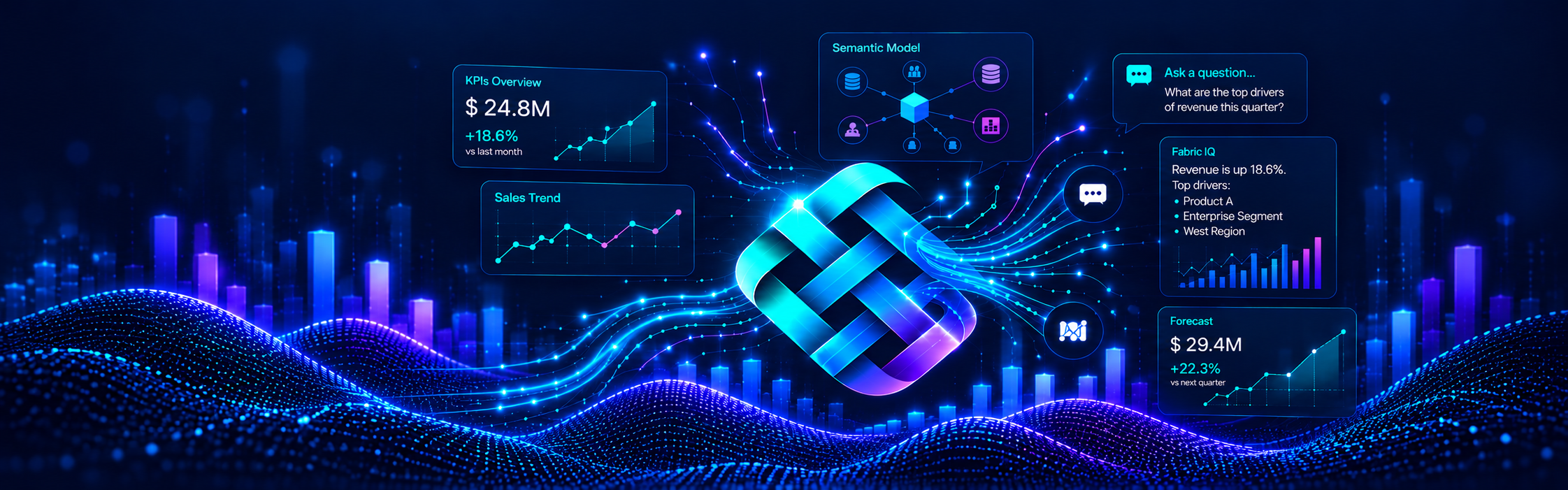
Originally published August 10, 2026. Updated October 2026 to reflect current Fabric IQ terminology and capabilities.
Welcome to Generative BI with Fabric IQ!
Key takeaway: Generative BI promises natural-language access to business data, but accurate results require far more than SQL generation. AI needs rich business context, and Fabric IQ is Microsoft’s approach to providing that context across semantic models, ontologies, graph, and agents.
The Landscape
Over the past 3 months, I've had the privilege of interviewing dozens of Business Intelligence (BI) leaders on the intersection of Artificial Intelligence (AI) and BI.
While these BI leaders have come from all manner of industries, including healthcare, financial services, manufacturing, etc., I overwhelmingly heard the same message:
You can think of Generative BI as being the ultimate in self-service analytics:
A business stakeholder opens up a chat window.
The business stakeholder asks for something in natural language (e.g., "How much money did we make last quarter for product X in region Y for segment Z?").
The AI agent translates the natural language as needed (e.g., translating "How much money" into the proper terminology of Profit).
The AI agent performs all needed queries and calculations.
The correct answer is returned to the business stakeholder.
Generative BI is the term I've most commonly heard for the above scenario, but another commonly used term is "conversational analytics."
Sounds Too Good to Be True, Doesn't It?
If you've been in analytics as long as I have, you might be rolling your eyes right now.
True self-service analytics has been a dream for so long. For example, it wasn't too long ago that Tableau made waves in the industry by selling not to IT, but directly to business teams.
However, years later, it's still exceedingly rare for me to encounter an organization where there's widespread use of BI tools like Tableau and Power BI in business teams.
Arguably, the problem with every previous iteration of self-service analytics was the same:
There was an expectation that business teams would be willing to learn the skills needed to effectively use these tools because the value of self-service was so high.
It appears that the market has spoken, and this long-running technology anti-pattern has repeated.
This is nothing new. Back in the 1950s, COBOL was invented to allow business users to write their own programs. If you don't know what COBOL is, take it from me. COBOL was widely used in IT organizations, not by business teams.
BTW - My first coding job was maintaining COBOL systems on an IBM mainframe. 🤣
So What's Different This Time?
I'm going to risk you rolling your eyes again for what I'm going to say next.
What's different about self-service analytics this time is AI.
Because large language models (LLMs) are so proficient with the ambiguity of natural language, they are far more likely to succeed than any other previous attempt.
Why?
Because, when done right, LLMs allow users to get the analytics they need without having to learn any skills - and that includes learning the "data lingo" of their organizations.
As the hypothetical example above demonstrates, when Generative BI is done right, business stakeholders don't even have to use the correct column names when they ask for information they need (e.g., "How much money" vs. "Profit").
Here's the thing, though.
Generative BI done right is a lot more than simply generating SQL code from business stakeholders' natural language questions/prompts.
Here's the Catch
Anthropic (the makers of Claude Code) recently published a super informative article about the realities of Generative BI. If you haven't read it, I would highly suggest taking the time to read it because of the underlying message:
Getting to the high level of accuracy needed for real-world Generative BI is a lot of work. And generating the SQL is the easy part.
For example, Anthropic's first iteration of Generative BI never exceeded about 21% accuracy.
What Anthropic found was that as soon as they provided the AI with all the definitions, column mappings, proper grains, filters, etc., SQL generation was straightforward
The low accuracy was not the result of malformed SQL, but the result of interpretation problems. For example, mapping natural language business concepts to the wrong tables.
So, what did Anthropic do?
They built domain-specific Claude Skills. When these skills were built, they report overall accuracy rose from about 21% to an average of 95%. Even as high as 99% in some domains!
In case you're not familiar with Claude Skills or LLMs in general, here's an easy way to think about it:
These Claude Skills provide a tremendous amount of metadata to the AI, specific to a business domain.
In AI, this idea is often called "context."
Essentially, LLMs need a lot more than a relational database schema to get the context they need to provide real-world (i.e., accurate) Generative BI.
Enter Fabric IQ
Currently in Preview, Microsoft's solution to providing AI the context needed to deliver real-world Generative BI is Fabric IQ.
Like many of Microsoft's cloud-based SaaS offerings, you can think of Fabric IQ as an umbrella that encompasses many components:
Fabric itself (e.g., unified data storage via OneLake)
Fabric Data Agents
Fabric Graph
You can think of the above shortlist as being the basic building blocks for Generative BI aimed at organizations that have chosen Microsoft Fabric / Microsoft stack.
Where Anthropic has used Claude Skills to provide the context required for Generative BI, Fabric Ontology and Fabric Graph provide the required context for Generative BI in Azure.
BTW - Here's a preview of coming attractions:
While Power BI semantic models are helpful for delivering real-world Generative BI, they are insufficient on their own.
The key to real-world Generative BI using Fabric will be designing Fabric Ontologies to provide rich context to Fabric Data Agents.
The design skills required for Fabric Ontologies are different than the design skills for Power BI semantic models.
What to Expect from this Newsletter
This newsletter will focus exclusively on the journey of building real-world Generative BI solutions using Fabric IQ - the good, the bad, and the ugly.
Fabric IQ is currently in Preview. That means that a lot will change over the next 6-12 months. As a result, I fully expect some early articles will become outdated (e.g., user interface and feature changes).
Because of this, I will be targeting early articles on fundamental concepts that will not change. For example, the importance of fact-based and graph modeling in building Generative BI systems with Fabric IQ the right way.
My goal is to publish 2 articles per month documenting this journey.
Welcome aboard!
Greetings! I’m Dave Langer
Author | Microsoft MVP | LinkedIn Top Voice

I help Power BI teams move past dashboards to Generative BI using Microsoft Fabric and Fabric IQ.
If your organization is serious about enterprise-class conversational analytics, we should talk.