
Originally published August 17, 2026. Updated October 2026 to reflect current Fabric IQ terminology and capabilities.
Generative BI: Beyond Conversational Analytics
Key takeaway: <Need Content />
What’s Next for Business Intelligence?
I've been doing analytics for 14+ years, and for most of that time, dashboards have been synonymous with Business Intelligence (BI).
I've led data teams at companies like Schedulicity and Microsoft, and the BI work is always the same:
We build semantic models.
We create reports, dashboards, and scorecards.
We add slicers, filters, drill-through pages, and tooltips.
Then we deliver the finished product to business stakeholders and hope that, between requirements gathering and our own knowledge, we've anticipated all the needs.
And, as we all know, the following question is all too common:
"This is great. Can I export it to Microsoft Excel?"
While I use AI daily in my work as an independent consultant and trainer, I'm not a LinkedIn "AI Bro." I've been in technology too long to blindly embrace the latest Hype Cycle.
However, I do believe that Generative AI is beginning to change things in the BI space.
Imagine a world where, instead of navigating to a dashboard, a business stakeholder can simply ask a question in natural language:
"Which distributors are growing the fastest this year?"
That sounds like Conversational Analytics. And it is.
But I think Conversational Analytics is only part of a much bigger change for BI teams.
I call that change Generative BI.
The BI Interface Is Changing
Traditional BI is based on a predefined interface. And I mean more than whether the user interface is a tabular report, dashboard, or scorecard. For example, someone decides:
Which metrics matter.
Which dimensions users should analyze.
Which charts should appear in the interface.
Which paths users can take through the data.
That model has worked extremely well. I certainly don't think dashboards are going away.
But even the best-designed dashboards have an important limitation: they can only anticipate so much.
Once again, the following question is evidence of this:
"This is great. Can I export it to Microsoft Excel?"
All joking aside, consider a sales manager who is looking at revenue by distributor.
What the sales manager sees raises another question about geography. Then another about product mix. Then another about whether the pattern is new or has existed for years.
A well-designed dashboard might support some of those questions. And maybe it would support all of them.
But I would bet $1,000 it doesn't take long before the sales manager is asking questions nobody anticipated - even the sales team.
Generative AI introduces a different model.
Instead of requiring business stakeholders and the BI team to anticipate every question, users can increasingly express what they want to know in natural language.
That is a major change. But natural language alone isn't enough.
What is Conversational Analytics?
I'll be the first to admit that applying Generative AI to BI is still in the very early days. One part of that is that we don't have standardized terminology. So, here's my definition of Conversational Analytics:
Conversational Analytics is the ability to interact with business data using natural language.
Instead of finding the right report, visual, field, filter, or measure, the user asks a question such as:
"What were sales of Product X in North America last quarter?"
The system interprets the question, queries the appropriate data, and returns an answer.
For business users, the appeal is obvious.
They don't need to know column names. They don't need to know SQL. They don't need to know DAX.
In many cases, they don't even need to know exactly where the data lives.
They ask a business question and get a business answer.
This is an important capability, and Microsoft Fabric data agents show where the technology is headed.
A Fabric data agent can answer natural-language questions using sources that include warehouses, lakehouses, Power BI semantic models, and Fabric IQ ontologies.
But here's the distinction I think matters:
A conversation is an interface. It isn't the intelligence itself.
Chat makes BI easier to access. Generative BI could change what the BI system can actually do.
What is Generative BI?
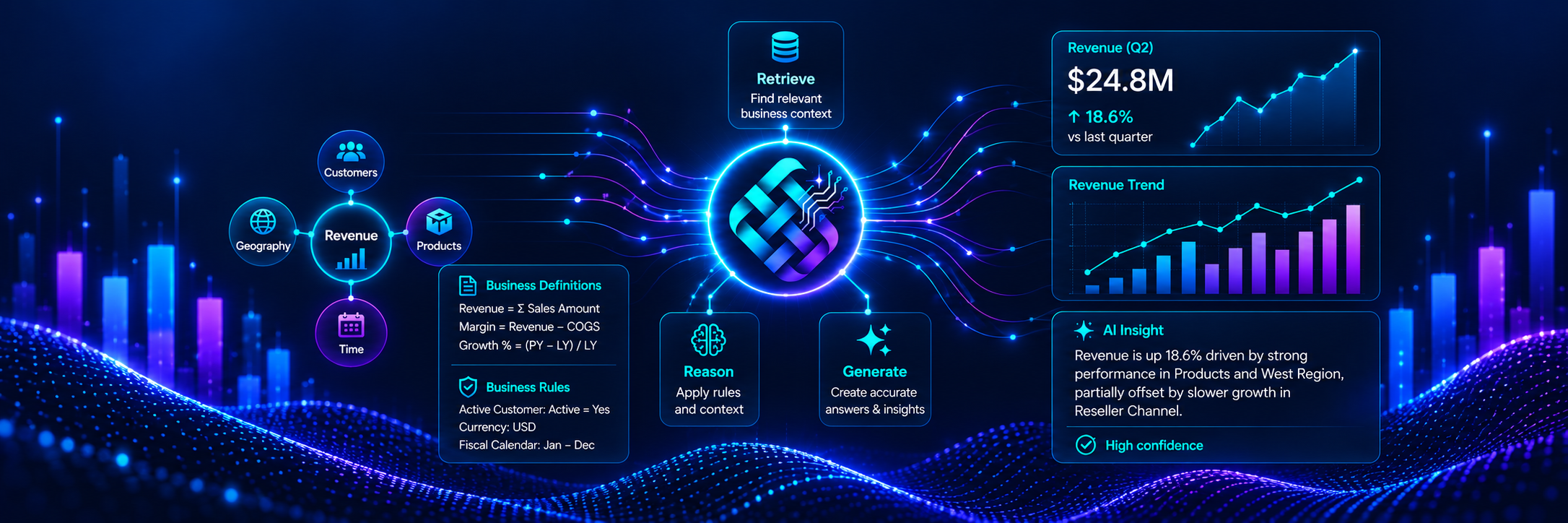
I use the term Generative BI to describe applying Generative AI to Business Intelligence, grounded in trusted business data and meaning. Conversational Q&A is part of that. But the opportunity is broader.
A Generative BI system might help a user:
Answer a business question.
Explain why a metric changed.
Connect related business concepts.
Identify unusual patterns for investigation.
Compare one part of the business with another.
Eventually guide stakeholders to take appropriate action.
The shift is subtle but important.
Traditional BI mostly gives users information that someone has already organized for them.
Conversational Analytics lets users request information more naturally.
Generative BI moves toward a system that can work with the user to understand the business.
That requires much more than simply connecting a large language model (LLM) to a database and letting it generate SQL.
Conversational Analytics vs. Generative BI
One useful way to think about the difference is this:
Conversational Analytics describes how you interact with the system. Generative BI describes what the system can do.
You can put a chat interface on top of almost anything. But imagine a sales manager asking:
"Which distributors should the sales team focus on next quarter?"
That’s very different than the sales manager asking:
"What were distributor X's sales last year?"
The second question is primarily a data-retrieval problem.
The first requires much more context. What does "focus on" mean?
Best fit for the current business strategy?
Largest untapped potential?
Highest current revenue?
Fastest growth?
Lowest risk?
The system needs to understand more than tables and columns. It needs to understand the business concepts behind the data.
And this is where I think Generative BI becomes especially interesting for BI professionals.
Why Semantics Become Critical
Large language models (LLMs) are remarkably good at working with language.
That doesn't mean they automatically understand your business.
Consider a data warehouse containing columns like:
OrderQuantity
SalesAmount
ResellerID
ProductID
DateID
A BI professional can probably make sense of those fields. But knowing what a field is called is not the same as understanding what it means:
Which sales measure should be used for an executive revenue question?
Which date represents when a sale should be recognized?
How does the company define a high-value distributor?
Which relationships are valid for a particular analysis?
What business rules need to be respected?
The answers to the above questions live in an architectural construct commonly called the semantic layer.
This is why I believe semantic enrichment will become one of the most important responsibilities of BI teams in the age of Generative AI.
The better you can describe the business's meaning, the better chance an AI system has of producing useful, consistent, and trustworthy answers. In other words:
Giving AI access to data is not the same thing as giving AI understanding of the business.
Why Fabric IQ Matters
This is why I've become obsessed with Microsoft Fabric IQ.
Microsoft describes Fabric IQ as a workload for unifying business semantics across data, models, and systems.
One of its central capabilities is the ontology, which provides a shared business model that agents and other Fabric components can use as context.
If the word ontology sounds intimidating, don't worry. I'll spend plenty of time on it in future editions.
For now, think of an ontology as a way to describe the business using concepts and relationships the business actually understands
Instead of focusing first on tables such as FactDistributorSales and DimDistributor, you can begin thinking in terms of concepts such as:
Distributor resells Product.
Distributor resells in Geography.
Sales Orders contain sold Products.
You can then connect these concepts back to the actual data. This is what the semantic layer must provide to achieve real-world Generative BI.
Oh, and in case you're concerned I'm advocating a "boil the ocean" approach to rolling out Generative BI, check this out.
Fabric IQ can generate an ontology from an existing Power BI semantic model.
That means organizations don't necessarily have to abandon years of semantic modeling work to begin exploring this new approach.
Quite the opposite.
A well-designed Power BI semantic model can become an important starting point.
The Bigger Shift for BI Teams
This may be one of the biggest changes ahead for BI professionals. Historically, a large portion of BI work has focused on creating the presentation layer:
What reports/dashboards/scorecards should be built?
How should users navigate them?
What visuals should be used?
Those questions will still matter. But Generative BI increases the value of another question:
How well have we described the business to AI?
That means definitions matter. Descriptions matter. Measures matter. Relationships matter. Business terminology matters. Rules matter.
And semantic models matter.
This is why I don't see Generative AI as making BI professionals less important.
I think it changes where some of our value will come from.
If AI becomes the interface through which more people interact with business data, then someone still needs to make sure the AI understands what revenue means, how customers relate to orders, which metrics are authoritative, and which business rules apply.
That sounds a lot like BI work to me.
Where to Go From Here
This newsletter will explore that idea in depth - how do we describe the business well enough to arrive at Generative BI? My focus will be practical.
How BI teams can use the skills, models, and data assets they already have to prepare for a world in which people increasingly interact with business data through AI.
Microsoft Fabric IQ will be the primary technology I use to explore these ideas, but the larger topic is Generative BI:
What role should Power BI semantic models play?
How do you give AI reliable business context?
When do you need a Fabric IQ ontology?
How should the ontology be designed?
And what does all of this mean for the future role of ’s future role?
Those are the questions I plan to investigate.
Next up, I'll start with what I believe is the foundation for everything else:
Greetings! I’m Dave Langer
Author | Microsoft MVP | LinkedIn Top Voice

I help Power BI teams move past dashboards to Generative BI using Microsoft Fabric and Fabric IQ.
If your organization is serious about enterprise-class conversational analytics, we should talk.