

Join 1,000s of professionals who are building real-world skills for better forecasts with Microsoft Excel.
Issue #54 - Text Mining with Python Part 1:
Tokenization
This Week’s Tutorial
So many organizations still analyze free-form text data by hand. STOP! The process is costly, biased, and produces dubious insights.
Even in 2026, I still see clients using processes like this:
Capture text data from some process (e.g., surveys, chats, etc.).
Put the text data in a Microsoft Excel workbook.
Have a human periodically read the text, interpret it, and then label it.
The labels are then used to make business decisions.
Periodically, this onerous task is reassigned to another human.
Every human interprets the text differently.
Here's the good news. Microsoft knows that free-form text exists in Excel workbooks in all manner of organizations around the world.
That's why Microsoft added the libraries you need to mine free-form text data in a standardized, repeatable way, using Python in Excel. And no, you don't have to be a software engineer or data scientist to learn this stuff.
This tutorial series is designed for ANY professional to learn powerful techniques for extracting value from free-form text data.
Tokenization
Before free-form text can be analyzed using a computer, it must be transformed into a representation that computers can understand. This end-to-end process is often referred to as a pipeline.
Tokenization is the first step in a text pre-processing pipeline. Tokenization breaks a text into smaller, meaningful units called tokens. Tokens typically represent individual words or numbers.
However, tokens can also represent punctuation, symbols, emoticons (e.g., :-D), and emojis (e.g., 😁). Tokens can also represent entire paragraphs or sentences of a document.
Given the importance of tokenization to text mining, Microsoft has included the mighty Natural Language Toolkit (NLTK) library in Python in Excel. The NLTK provides you with a wealth of functionality for mining free-form text.
This tutorial series will use many of NLTK's capabilities, but first, I will cover the basics.
BTW - While I'm using Python in Excel for this tutorial series, the code is 99% the same whether you're using Microsoft Excel or a technology like Jupyter Notebook.
Basic Tokenization
The easiest way to understand tokenization is to see it in action. So, here's the simplest use case of tokenization I can think of: splitting free-form text into tokens using spaces.
If you want to follow along (highly recommended), fire up Microsoft Excel and access Python in Excel using the new Python Editor by navigating to Formulas in the Ribbon:
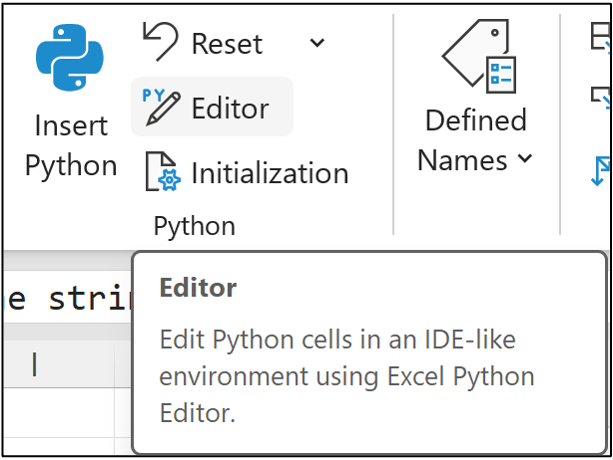
In response, the Python Editor pane will be displayed:
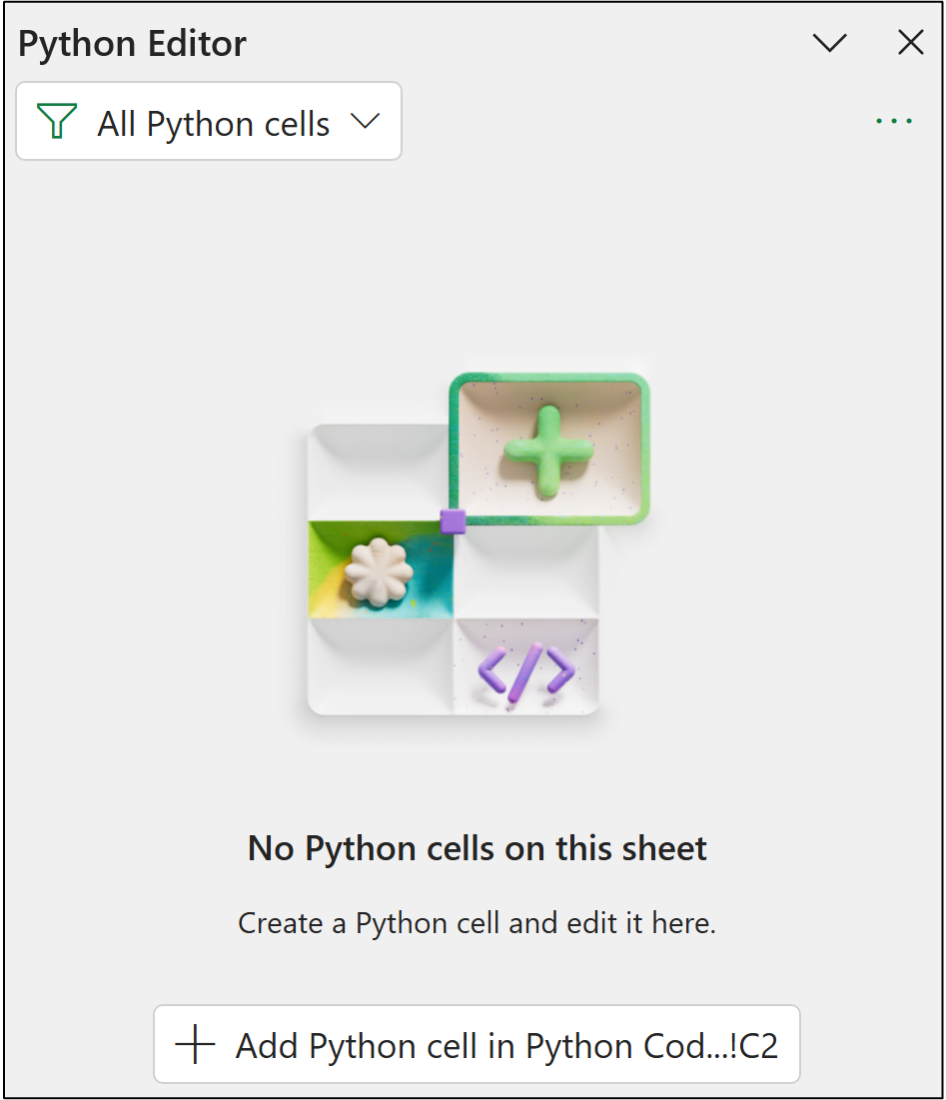
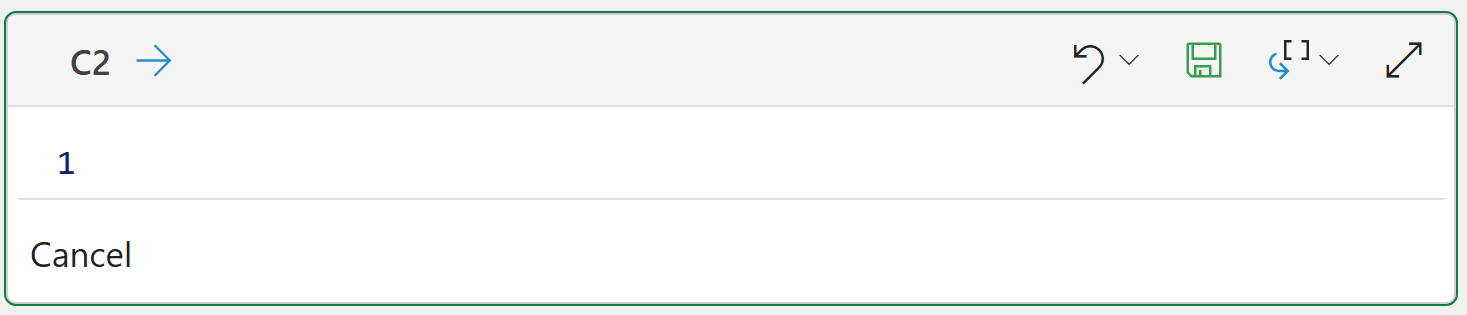
I typically store my Python in Excel code in a worksheet called Python Code. Within this worksheet, I typically arrange all my Python formulas in a single column, starting with cell C2.
Clicking the Add Python cell in... button changes cell C2 to Python mode, where you can use the Python Editor to write your code:
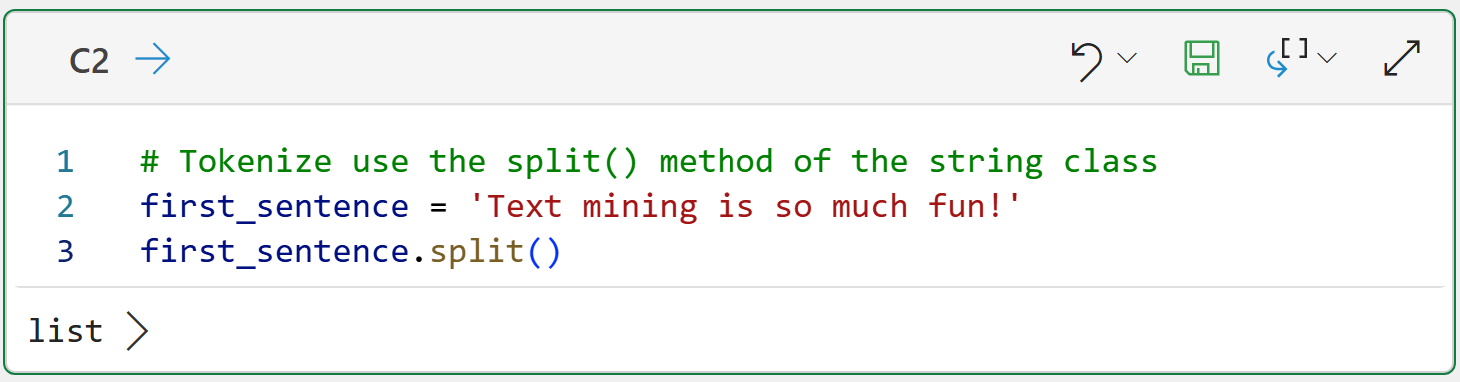
The following Python formula demonstrates the simplest tokenization use case by using the functionality provided by Python's string class:
BTW - If you're new to Python, check out my book, Python in Excel Step-by-Step. It will teach you the Python foundation you need for analytics fast.
The split() method does what you would expect - it splits the data into pieces (i.e., tokens) by using spaces to separate each token. Clicking on list > shows the results returned:
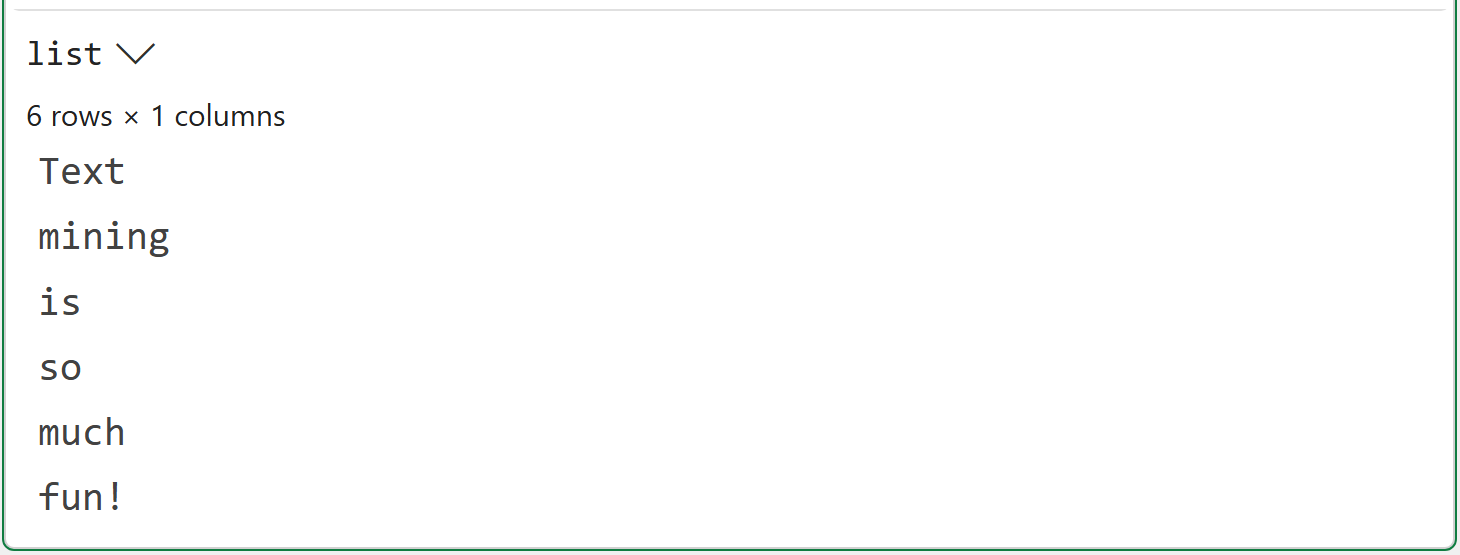
While the output above looks good on the surface, it exposes one of the subtle difficulties of proper tokenization - handling punctuation.
In this case, the last token (i.e., fun!) combines two pieces of information:
The word fun conveys a specific meaning in the text (i.e., that text mining is enjoyable).
The exclamation mark (i.e., !) conveys emphasis regarding the enjoyment of text mining (e.g., a comparison to using a period instead).
Here's another example:
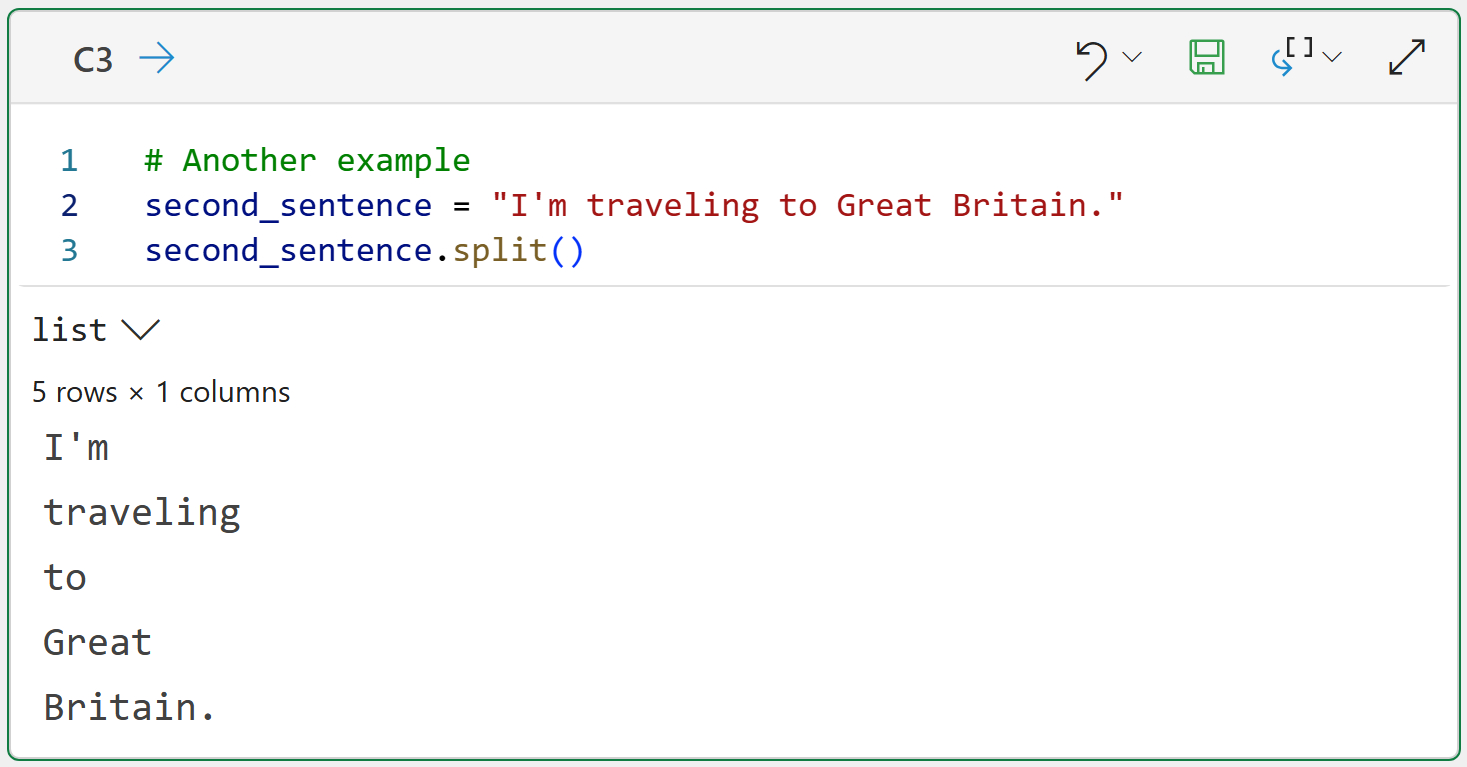
The code above demonstrates a couple more tokenization problems that need to be addressed:
The token I'm is the contraction of I am. Ideally, this would be two tokens, not one.
The proper noun Great Britain has been split into two tokens when it should be one.
I will be addressing the first issue in this tutorial series. The second issue is known as named entity recognition (NER). The NLTK offers NER support, but it is beyond the scope of this tutorial.
So, putting this all together, simply splitting on spaces is not enough. You need smarter tokenization.
Enter the mighty NLTK.
Basic Tokenization With the NLTK
Given the importance of tokenization, it should come as no surprise that the NLTK provides out-of-the-box support for smarter tokenization through its tokenizers.
I just love it when names make sense. Tokenizers perform tokenization on free-form text and produce tokens. Woohoo! The simplest NLTK tokenizer is word_tokenize():
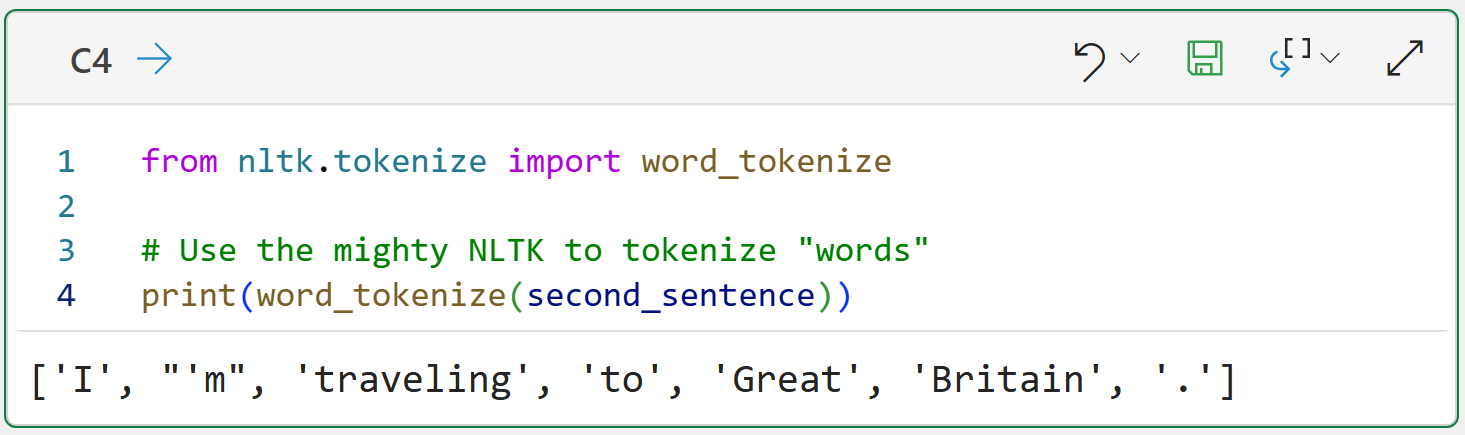
As shown in the output above, word_tokenize() is a big improvement from just splitting on spaces:
It recognizes I'm and splits it into two tokens (i.e., 'I' and "'m").
It recognizes punctuation (i.e., the period) and creates a dedicated token.
There's a problem here, though. Most free-form text is more than just a single sentence.
Sentence Tokenization
Consider the following example of where the free-form text consists of two sentences. You could apply the NLTK's word_tokenize() function to the data:
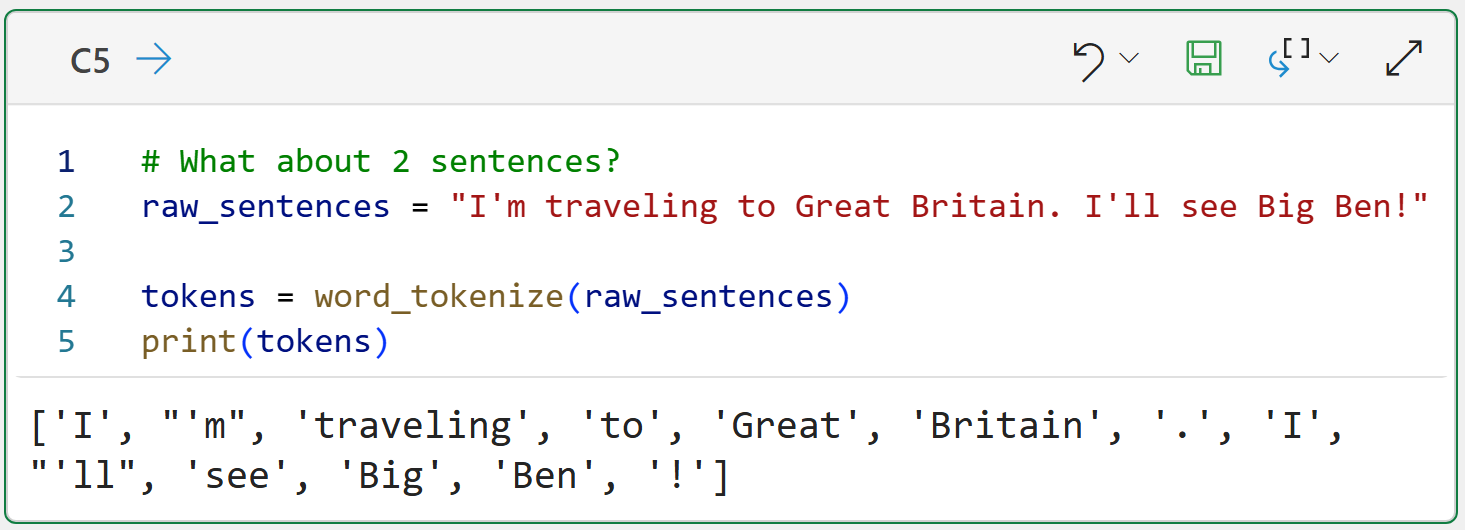
While there's a lot to like in the above output (e.g., contractions and punctuation), there's one show-stopper problem. The output doesn't recognize sentence boundaries, it's just one big list of all the tokens.
As you might have guessed, the NLTK has a tokenizer to handle sentences, sent_tokenize():
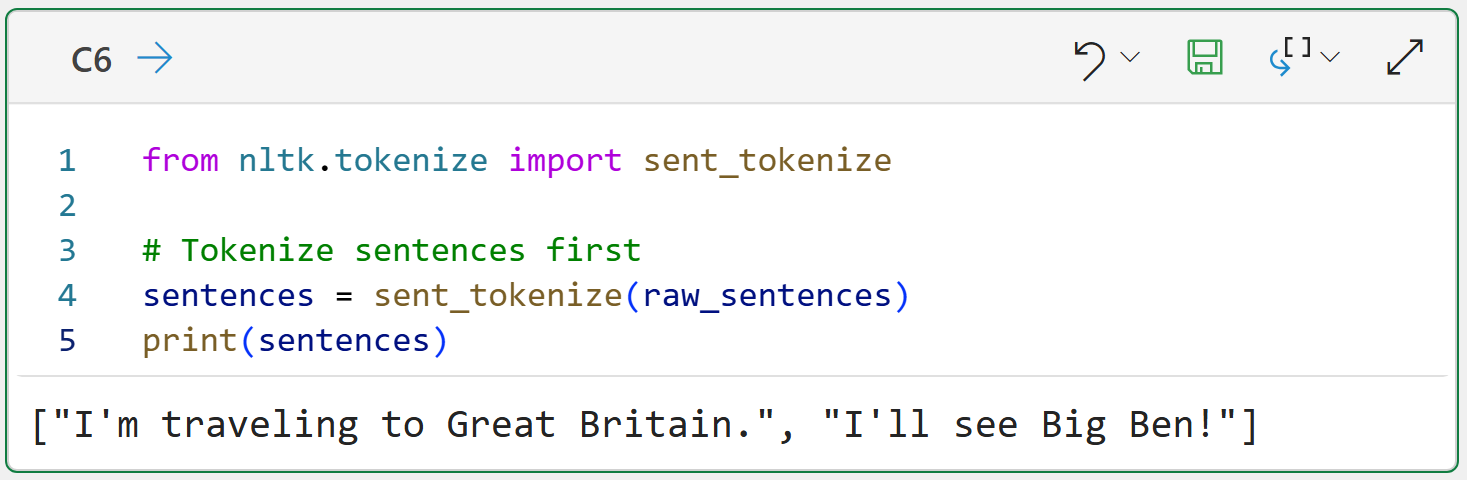
The output above shows a common pattern when working with the NLTK - you will be working with Python lists a lot. In this case, sent_tokenize() returns a list of strings. Each string corresponds to a sentence.
Another way to think about this is that the tokenizers break free-form text into smaller pieces:
sent_tokenize() breaks free-form text into tokens that are full sentences.
word_tokenize() breaks free-form sentences into word tokens.
From this perspective, tokenizers are building blocks you use to build your text pre-processing pipeline. Here's an example of taking a document composed of two sentences and tokenizing into individual word tokens:
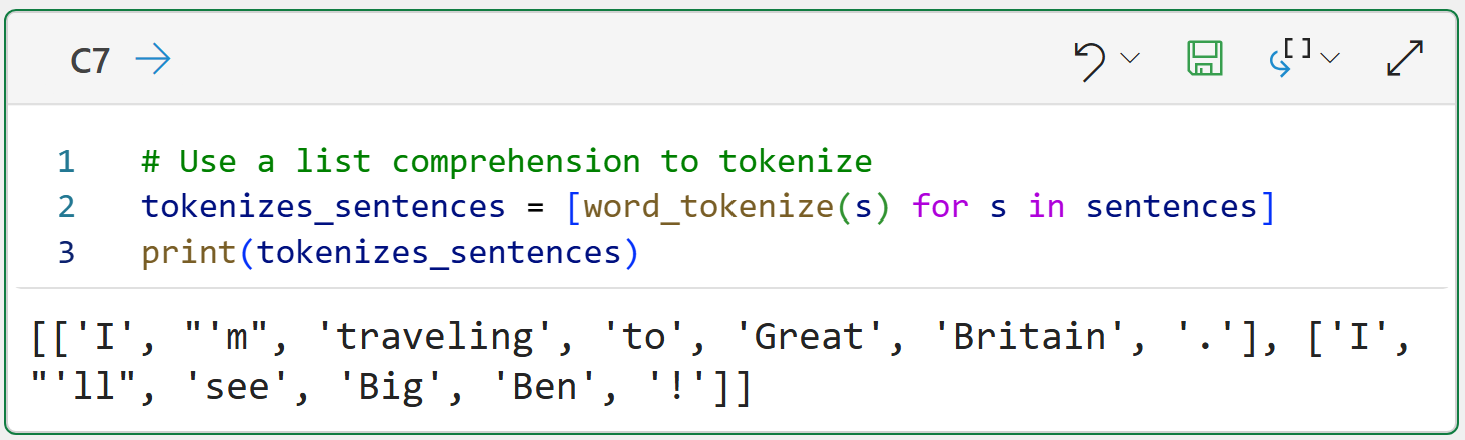
The above Python formula demonstrates a simple text pre-processing pipeline:
The code in cell C6 tokenizes the document into a list of strings named sentences.
The code in cell C7 iterates through each sentence and uses word_tokenize() on each sentence.
The tokenized sentences are returned as a list (i.e., sentences) of lists (i.e., sentence tokens).
The magic behind steps 2 and 3 is a Python list comprehension. When mining text data using the NLTK, you write a lot of list comprehensions. So, let's consider what's going on in line 2 of the code in cell C7 at a conceptual level:
The sentences variable is an object containing two strings.
The in sentences tells the list comprehension to look at each string one at a time.
The for s tells the list comprehension to name each string s.
The word_tokenize(s) tokenizes each sentence into words.
The list comprehension gathers the output from all the calls to work_tokenize(s) into a list and returns it.
Future tutorials in this series will extend this text pre-processing pipeline.
This Week’s Book
Since the NLTK will figure heavily in this tutorial series, I will once again mention the following book that is available online for free:
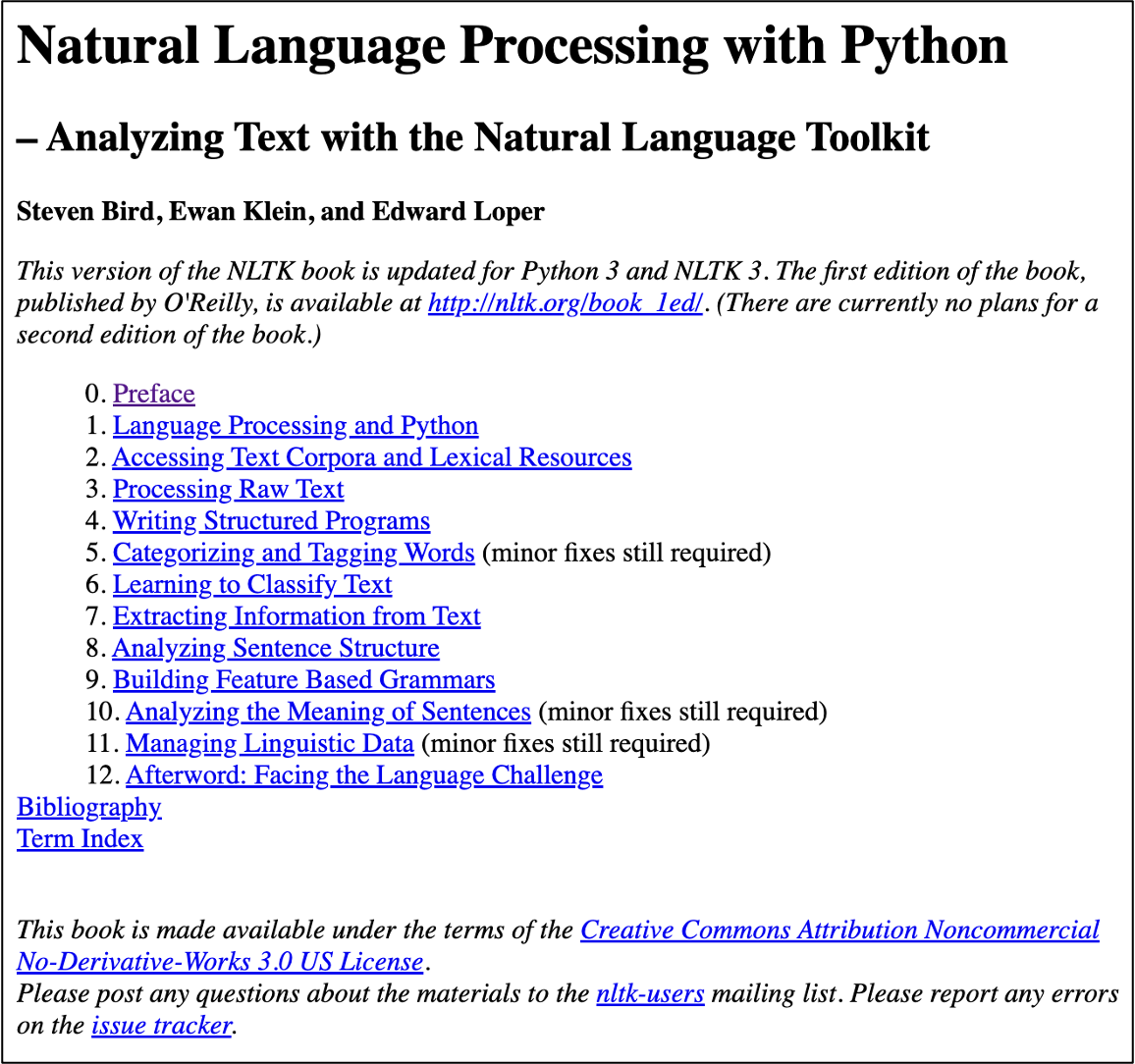
There's no better introduction to the NLTK than this book, which covers many topics (e.g., NER) that are out of scope for this tutorial series.
That's it for this week.
Next week's newsletter covers the next stage of the text pre-processing pipeline - token normalization.
Stay healthy and happy data sleuthing!

Dave Langer
Whenever you're ready, here are 3 ways I can help you:
1 - The future of Microsoft Excel forecasting is unleashing the power of machine learning using Python in Excel. Do you want to be part of the future? Order my book on Amazon.
2 - Are you new to data analysis? My Visual Analysis with Python online course will teach you the fundamentals you need - fast. No complex math required, and Copilot in Excel AI prompts are included!
3 - Cluster Analysis with Python: Most of the world's data is unlabeled and can't be used for predictive models. This is where my self-paced online course teaches you how to extract insights from your unlabeled data. Copilot in Excel AI prompts are included!